Clone (Deep Copy) Binary Tree With Random Pointer using Hash Map
- 时间:2020-09-08 11:19:41
- 分类:网络文摘
- 阅读:157 次
A binary tree is given such that each node contains an additional random pointer which could point to any node in the tree or null. Return a deep copy of the tree.
The tree is represented in the same input/output way as normal binary trees where each node is represented as a pair of [val, random_index] where:
val: an integer representing Node.val
random_index: the index of the node (in the input) where the random pointer points to, or null if it does not point to any node.You will be given the tree in class Node and you should return the cloned tree in class NodeCopy. NodeCopy class is just a clone of Node class with the same attributes and constructors.
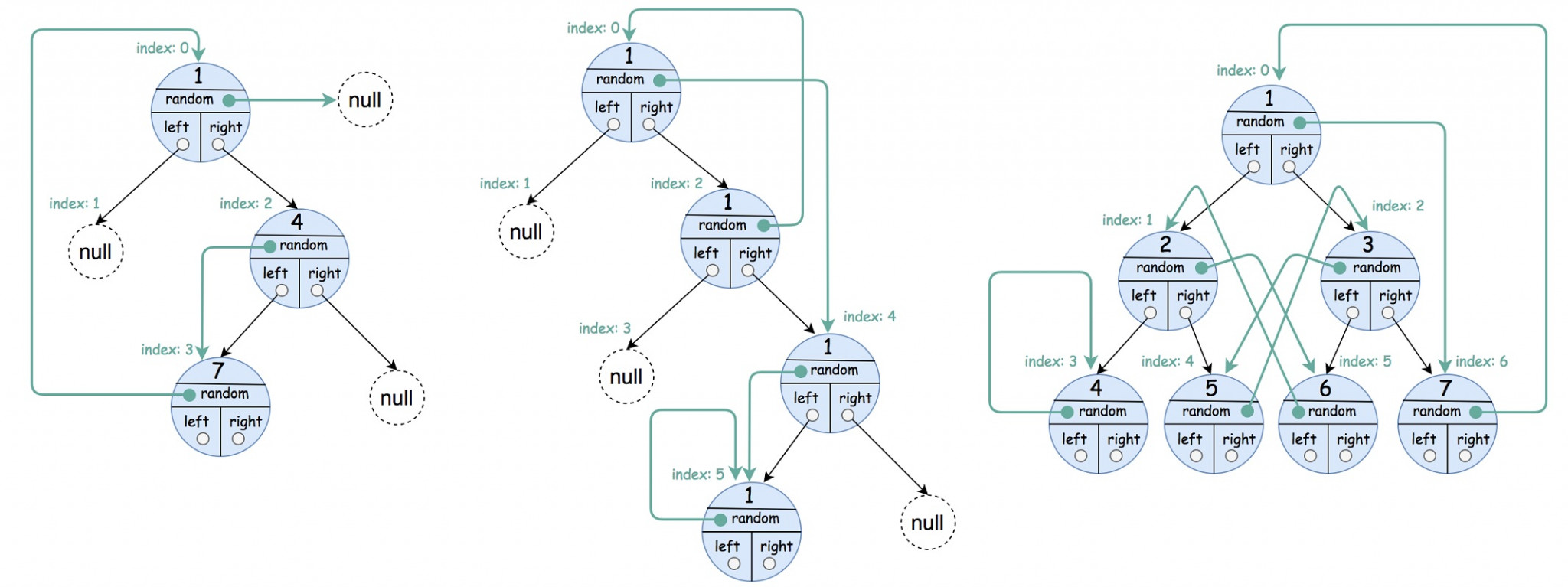
Example 1, 2 and 3: Deep Copy Binary Tree with Random Pointer
clone-binary-tree-with-random-pointer
Example 1:
Input: root = [[1,null],null,[4,3],[7,0]]
Output: [[1,null],null,[4,3],[7,0]]
Explanation: The original binary tree is [1,null,4,7].
The random pointer of node one is null, so it is represented as [1, null].
The random pointer of node 4 is node 7, so it is represented as [4, 3] where 3 is the index of node 7 in the array representing the tree.
The random pointer of node 7 is node 1, so it is represented as [7, 0] where 0 is the index of node 1 in the array representing the tree.Example 2:
Input: root = [[1,4],null,[1,0],null,[1,5],[1,5]]
Output: [[1,4],null,[1,0],null,[1,5],[1,5]]
Explanation: The random pointer of a node can be the node itself.Example 3:
Input: root = [[1,6],[2,5],[3,4],[4,3],[5,2],[6,1],[7,0]]
Output: [[1,6],[2,5],[3,4],[4,3],[5,2],[6,1],[7,0]]Example 4:
Input: root = []
Output: []Example 5:
Input: root = [[1,null],null,[2,null],null,[1,null]]
Output: [[1,null],null,[2,null],null,[1,null]]Constraints:
The number of nodes in the tree is in the range [0, 1000].
Each node’s value is between [1, 10^6].Hints:
Traverse the tree, keep a hashtable with you and create a nodecopy for each node in the tree.
Start traversing the original tree again and connect the left, right and random pointers in the cloned tree the same way as the original tree with the help of the hashtable.
Recursive Deep Copy of Binary Tree with Hash Map
We can recursive copy the attributes/properties of the binary tree. Since the random pointers may cause endless loop (cycles), we need to use a hash map to remember the nodes that we always clone.
1 2 3 4 5 6 7 8 9 10 11 12 13 14 15 16 17 18 19 20 21 22 23 24 25 26 27 28 29 30 | /** * Definition for a Node. * struct Node { * int val; * Node *left; * Node *right; * Node *random; * Node() : val(0), left(nullptr), right(nullptr), random(nullptr) {} * Node(int x) : val(x), left(nullptr), right(nullptr), random(nullptr) {} * Node(int x, Node *left, Node *right, Node *random) : val(x), left(left), right(right), random(random) {} * }; */ class Solution { public: NodeCopy* copyRandomBinaryTree(Node* root) { if (!root) return NULL; if (memo.find(root) != memo.end()) { return memo[root]; } NodeCopy* newRoot = new NodeCopy(); memo[root] = newRoot; newRoot->val = root->val; newRoot->left = copyRandomBinaryTree(root->left); newRoot->right = copyRandomBinaryTree(root->right); newRoot->random = copyRandomBinaryTree(root->random); return newRoot; } private: unordered_map<Node*, NodeCopy*> memo; }; |
/**
 * Definition for a Node.
 * struct Node {
 *     int val;
 *     Node *left;
 *     Node *right;
 *     Node *random;
 *     Node() : val(0), left(nullptr), right(nullptr), random(nullptr) {}
 *     Node(int x) : val(x), left(nullptr), right(nullptr), random(nullptr) {}
 *     Node(int x, Node *left, Node *right, Node *random) : val(x), left(left), right(right), random(random) {}
 * };
 */
class Solution {
public:
    NodeCopy* copyRandomBinaryTree(Node* root) {
        if (!root) return NULL;
        if (memo.find(root) != memo.end()) {
            return memo[root];
        }
        NodeCopy* newRoot = new NodeCopy();
        memo[root] = newRoot;
        newRoot->val = root->val;
        newRoot->left = copyRandomBinaryTree(root->left);
        newRoot->right = copyRandomBinaryTree(root->right);
        newRoot->random = copyRandomBinaryTree(root->random);
        return newRoot;
    }
private:
    unordered_map<Node*, NodeCopy*> memo;
};When we immediately create a clone node, we need to put it in hash map before recursively calling deep-copy function to clone the left, right, and the random pointers. The sequence matters otherwise a stackoverflow will occur due to endless cycles.
Similarly, we can apply such algorithm to clone a graph: How to Clone a Graph in C++/Java using Depth First Search Algorithm? (Graph and HashMap)
–EOF (The Ultimate Computing & Technology Blog) —
推荐阅读:那些被人们误传的补充某种营养的食物 阿胶产品乱象:原料中被混入骡皮马皮 时令水果橘子橙子柚子营养价值大比拼 中医食疗:滋阴固肾的6款经典补粥 美味鸭肉的保健功效与养生食用方法 让枸杞中的营养成分吸收更好的吃法 多吃葱蒜少吃腌制食品防止胃病癌变 能够给肠道进行清洁排毒的常见食物 饮水养生:喝蜂蜜水的两个最佳时间 六类食物可以保护女性乳房不受伤
- 评论列表
-
- 添加评论