How to Convert Binary Number in a Linked List to Integer?
- 时间:2020-09-13 14:33:25
- 分类:网络文摘
- 阅读:146 次
Given head which is a reference node to a singly-linked list. The value of each node in the linked list is either 0 or 1. The linked list holds the binary representation of a number. Return the decimal value of the number in the linked list.
Example 1:
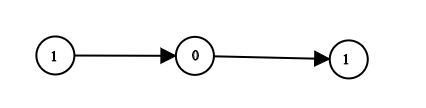
binary-linked-list
Input: head = [1,0,1]
Output: 5
Explanation: (101) in base 2 = (5) in base 10Example 2:
Input: head = [0]
Output: 0Example 3:
Input: head = [1]
Output: 1Example 4:
Input: head = [1,0,0,1,0,0,1,1,1,0,0,0,0,0,0]
Output: 18880Example 5:
Input: head = [0,0]
Output: 0Constraints:
The Linked List is not empty.
Number of nodes will not exceed 30.
Each node’s value is either 0 or 1.Hints:
Traverse the linked list and store all values in a string or array. convert the values obtained to decimal value.
You can solve the problem in O(1) memory using bits operation. use shift left operation ( << ) and or operation ( | ) to get the decimal value in one operation.
The MSB (Most Significant Bit) or the Binary Number is the Head of the linked-node, thus by following the linked nodes in the list, we can use the OR bitwise to shift the current value one position to the left and use the bitwise OR to take the current node.
1 2 3 4 5 6 7 8 9 10 11 12 13 14 15 16 17 18 19 | /** * Definition for singly-linked list. * struct ListNode { * int val; * ListNode *next; * ListNode(int x) : val(x), next(NULL) {} * }; */ class Solution { public: int getDecimalValue(ListNode* head) { int r = 0; while (head) { r = (r << 1) | head->val; head = head->next; } return r; } }; |
/**
 * Definition for singly-linked list.
 * struct ListNode {
 *     int val;
 *     ListNode *next;
 *     ListNode(int x) : val(x), next(NULL) {}
 * };
 */
class Solution {
public:
    int getDecimalValue(ListNode* head) {
        int r = 0;
        while (head) {
            r = (r << 1) | head->val;
            head = head->next;
        }
        return r;
    }
};We can also, use the math formula: (101, base two) = 1*2^2+0*2^1+1*2^0.
1 2 3 4 5 6 7 8 9 10 11 12 13 14 15 16 17 18 19 | /** * Definition for singly-linked list. * struct ListNode { * int val; * ListNode *next; * ListNode(int x) : val(x), next(NULL) {} * }; */ class Solution { public: int getDecimalValue(ListNode* head) { int r = 0; while (head) { r = r * 2 + head->val; head = head->next; } return r; } }; |
/**
 * Definition for singly-linked list.
 * struct ListNode {
 *     int val;
 *     ListNode *next;
 *     ListNode(int x) : val(x), next(NULL) {}
 * };
 */
class Solution {
public:
    int getDecimalValue(ListNode* head) {
        int r = 0;
        while (head) {
            r = r * 2 + head->val;
            head = head->next;
        }
        return r;
    }
};Both implementation require O(1) constant space, and the time complexity is O(N) where N is the number of the nodes in the linked-list.
–EOF (The Ultimate Computing & Technology Blog) —
推荐阅读:南瓜的养生功效:温润脾胃护心助眠 可以用豆浆替代牛奶来补钙吗? 早餐吃鸡蛋7大好处及快速烹调法 把虾皮作为补钙佳品还需三思而行 饮食健康:保护肝脏必吃8种蔬菜 常吃四种食物可有效排出体内毒素 哪种蔬菜是冬季餐桌上的“当家菜” 揭秘:吃腰子真能补肾壮阳吗? 冬季经常喝新鲜梨汁的九大好处 百果之王红枣的营养价值和保健功效
- 评论列表
-
- 添加评论