Implement the Depth First Search Algorithm in Graph using Simple
- 时间:2020-09-19 10:45:07
- 分类:网络文摘
- 阅读:151 次
Given a graph represented by G(V, E) where V is the vertices and E represents the edges, we can do a Depth First Search Algorithm (DFS) on any node/vertex. The DFS will mark the current node visited and visit the node using using the (*visit) function (C++ function pointer), and recursively call itself with the connected edges.
1 2 3 4 5 6 7 8 9 10 | void traverseDepthFirstSearch(int node, void(*visit)(int)) { link t; (*visit)(k); visited[k] = 1; // mark the node as visited for (t = adj[k]; t != NULL; t = t->next) { if (!visited[t->v]) { // avoid cycle traverseDepthFirstSearch(t->v, visit); } } } |
void traverseDepthFirstSearch(int node, void(*visit)(int)) {
  link t;
  (*visit)(k);
  visited[k] = 1; // mark the node as visited
  for (t = adj[k]; t != NULL; t = t->next) {
     if (!visited[t->v]) { // avoid cycle
         traverseDepthFirstSearch(t->v, visit);
     }
  }
}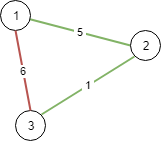
three-nodes
The algorithimic complexity is O(N) where N is the number of nodes connected to the given vertex. The space complexity is also O(N).
–EOF (The Ultimate Computing & Technology Blog) —
推荐阅读:我喜欢的经典作品550字 我们的学校小学作文 班里的新鲜事作文400字 写人作文顽童校长作文800字 诚信做人作文550字 秋天的礼物作文500字 贤妻良母发表日志:秋雨秋思何茫茫 关于元宵节的作文300字 写人作文“无赖”潘胜豪作文400字 我的读书生活700字
- 评论列表
-
- 添加评论