The Beginners’ Guide to Trie: How to Use the Trie in C++?
- 时间:2020-09-23 15:50:46
- 分类:网络文摘
- 阅读:145 次
The Trie is common used data structure to speed up the word searching. The Trie is a structure to index the words character by character.
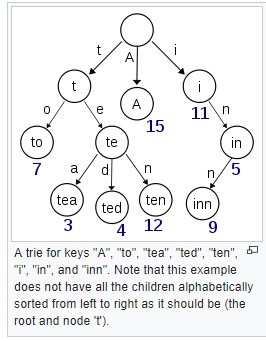
trie-example
Trie Definition in C++
Take a lowercase 26 letters for example, we can define a Trie node as a struct, as the follows:
1 2 3 4 5 | struct TrieNode { TrieNode* children[26] = { nullptr }; bool isWord = false; // denote if up to this point a word is complete string word = ""; // optional }; |
struct TrieNode {
    TrieNode* children[26] = { nullptr };
    bool isWord = false; // denote if up to this point a word is complete
    string word = ""; // optional
};Of course, you can define it as a class, but a Struct is lightweight, and serve the purpose. Each TrieNode will have an array of pointers indicating its next character. Meantime, it will have a boolean field to denote weather current node is the end of a word.
Insert/Index a Word in the Trie
First, we can declare a root node, then, we can call the following functoin to insert/index a word in the Trie.
1 2 3 4 5 6 7 8 9 10 11 12 13 14 15 | void insert(struct TrieNode* root, string key) { struct TrieNode *p = root; for (const auto &n: key) { int index = n - 'a'; if (p->children[index] == nullptr) { // not found, create a new child node p->children[index] = new TrieNode(); } // navigate the Trie Path p = p->children[index]; } // reaching the end of the word, mark it complete p->isWord = true; p->word = key; } |
void insert(struct TrieNode* root, string key) {
    struct TrieNode *p = root;
    for (const auto &n: key) {
        int index = n - 'a';
        if (p->children[index] == nullptr) {
            // not found, create a new child node
            p->children[index] = new TrieNode();
        }
        // navigate the Trie Path
        p = p->children[index];
    }
    // reaching the end of the word, mark it complete
    p->isWord = true;
    p->word = key;
}The indexing takes O(N) for inserting a word to the dictionary where N is the length of the word string.
Search a Word in the Trie
Given a root of TrieNode, we can easily follow the path until it has reached the end of the word i.e. the TrieNode’s isWord is true or NULL which indicates that the word is not in the dictionary.
1 2 3 4 5 6 7 8 9 10 11 12 | bool search(struct TrieNode* root, string key) { struct TrieNode *p = root; for (const auto &n: key) { int index = n - 'a'; // not found in the dictionary if (p->children[index] == nullptr) return false; // navigate to next letter p = p->children[index]; } // the current node is the end of the word return (p != nullptr) && (p->isWord); } |
bool search(struct TrieNode* root, string key) {
    struct TrieNode *p = root;
    for (const auto &n: key) {
        int index = n - 'a';
        // not found in the dictionary
        if (p->children[index] == nullptr) return false;
        // navigate to next letter
        p = p->children[index];
    }
    // the current node is the end of the word
    return (p != nullptr) && (p->isWord);
}Finding a word is O(N) where N is the number of the characters.
Example of Using Trie
1 2 3 4 | struct TrieNode *root = new TrieNode(); insert(root, "hello world!"); search(root, "hello"); // false search(root, "hello world!"); // true |
struct TrieNode *root = new TrieNode();
insert(root, "hello world!");
search(root, "hello"); // false
search(root, "hello world!"); // true
–EOF (The Ultimate Computing & Technology Blog) —
推荐阅读:光明牛奶“酸败门”牛奶变质事件 古井贡酒用食用酒精勾兑生产事件 伊利公司部分批次奶粉出现汞超标 立顿茶系列饮品被指农药超标 雅培配方奶粉被曝不符合安全标准 营养和安全:有机食品PK常规食品 蔬菜如何烹制,营养、健康又安全 八种简易食疗方,巧防春季流感 春季养生:喝花茶可护肝,预防感冒 农夫山泉被质疑标准不及自来水
- 评论列表
-
- 添加评论