SQL Inner Join Tutorial with Example: Managers with at Least 5 D
- 时间:2020-10-05 13:15:44
- 分类:网络文摘
- 阅读:152 次
Given the following SQL Schema:
Create table If Not Exists Employee (Id int, Name varchar(255), Department varchar(255), ManagerId int)
Truncate table Employee
insert into Employee (Id, Name, Department, ManagerId) values ('101', 'John', 'A', 'None')
insert into Employee (Id, Name, Department, ManagerId) values ('102', 'Dan', 'A', '101')
insert into Employee (Id, Name, Department, ManagerId) values ('103', 'James', 'A', '101')
insert into Employee (Id, Name, Department, ManagerId) values ('104', 'Amy', 'A', '101')
insert into Employee (Id, Name, Department, ManagerId) values ('105', 'Anne', 'A', '101')
insert into Employee (Id, Name, Department, ManagerId) values ('106', 'Ron', 'B', '101')
The Employee table holds all employees including their managers. Every employee has an Id, and there is also a column for the manager Id.
+------+----------+-----------+----------+
|Id    |Name 	  |Department |ManagerId |
+------+----------+-----------+----------+
|101   |John 	  |A 	      |null      |
|102   |Dan 	  |A 	      |101       |
|103   |James 	  |A 	      |101       |
|104   |Amy 	  |A 	      |101       |
|105   |Anne 	  |A 	      |101       |
|106   |Ron 	  |B 	      |101       |
+------+----------+-----------+----------+
Given the Employee table, write a SQL query that finds out managers with at least 5 direct report. For the above table, your SQL query should return:
+-------+
| Name  |
+-------+
| John  |
+-------+
Note:
No one would report to himself.
How does SQL Inner-Join Work?
The SQL Inner-Join (or often referred to as Join) can be easily illustrated using the following Venn Diagram:
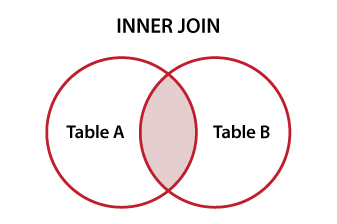
sql-joins-venn-diagrams-inner-join
Two tables are joined and the result is the intersection of two tables.
select Name from Employee as A
inner join (
    select ManagerId
    from Employee
    group by ManagerId
    having count(1) >= 5
) as B on A.ID = B.ManagerId
As we can see, two tables (queries) are joined using the keyword inner join (case insensitive) or join in short. You also need to specify the columns that connect two tables using syntax On.
SQL Sub Query
As of this problem, we can also use the sub query to solve.
select Name from
Employee where Id in (
 select ManagerId from Employee
 group by ManagerId
 having count(ManagerId) >= 5
)
This works slightly differently, the IDs from a query are returned and are used as inputs to another query (more or less like the pipe).
–EOF (The Ultimate Computing & Technology Blog) —
推荐阅读:在感冒发烧时应该如何安排饮食 十种常见食物搭配吃得营养又健康 日常食物怎样搭配吃出加倍营养? 秋冬季这样吃南瓜可防治便秘胃痛 三种豆子一起吃营养效果最好 红糖对女人健康有三大养生功效 南瓜的养生功效:温润脾胃护心助眠 可以用豆浆替代牛奶来补钙吗? 早餐吃鸡蛋7大好处及快速烹调法 把虾皮作为补钙佳品还需三思而行
- 评论列表
-
- 添加评论