How to Compute the Number of Pawns-Captures for Rook in Chess?
- 时间:2020-10-11 16:01:36
- 分类:网络文摘
- 阅读:190 次
On an 8 x 8 chessboard, there is one white rook. There also may be empty squares, white bishops, and black pawns. These are given as characters ‘R’, ‘.’, ‘B’, and ‘p’ respectively. Uppercase characters represent white pieces, and lowercase characters represent black pieces.
The rook moves as in the rules of Chess: it chooses one of four cardinal directions (north, east, west, and south), then moves in that direction until it chooses to stop, reaches the edge of the board, or captures an opposite colored pawn by moving to the same square it occupies. Also, rooks cannot move into the same square as other friendly bishops.
Return the number of pawns the rook can capture in one move.
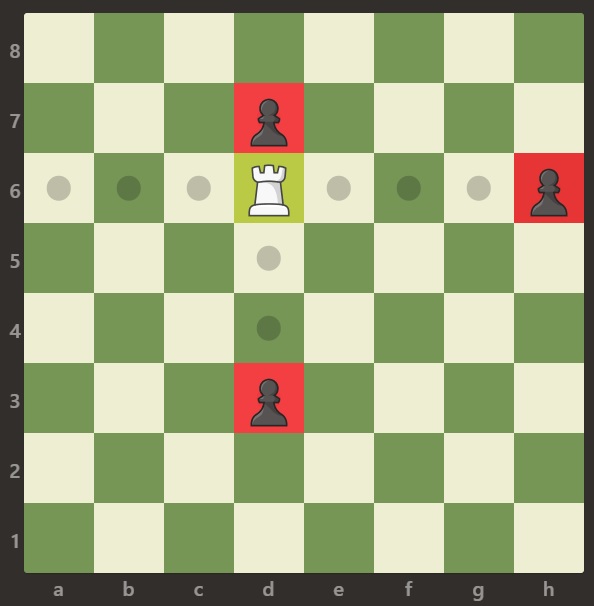
Example 1:
Available Captures for Rook
Input: [[".",".",".",".",".",".",".","."],[".",".",".","p",".",".",".","."],[".",".",".","R",".",".",".","p"],[".",".",".",".",".",".",".","."],[".",".",".",".",".",".",".","."],[".",".",".","p",".",".",".","."],[".",".",".",".",".",".",".","."],[".",".",".",".",".",".",".","."]]Output: 3
Explanation:
In this example the rook is able to capture all the pawns.Example 2:
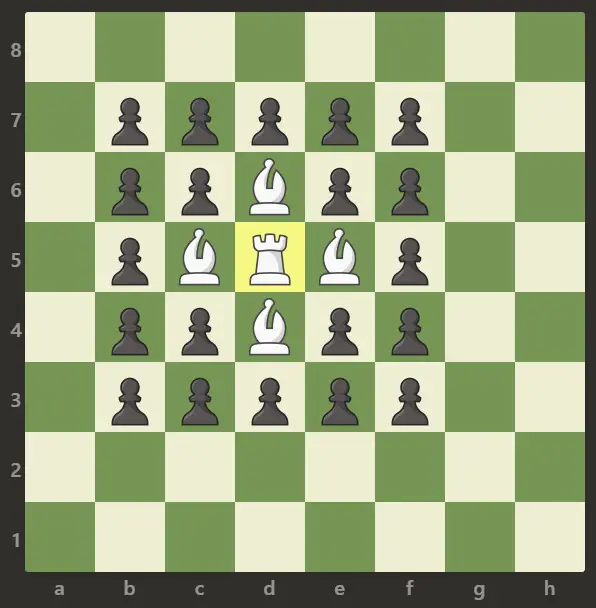
Available Captures for Rook
Input: [[".",".",".",".",".",".",".","."],[".","p","p","p","p","p",".","."],[".","p","p","B","p","p",".","."],[".","p","B","R","B","p",".","."],[".","p","p","B","p","p",".","."],[".","p","p","p","p","p",".","."],[".",".",".",".",".",".",".","."],[".",".",".",".",".",".",".","."]]Output: 0
Explanation:
Bishops are blocking the rook to capture any pawn.Example 3:
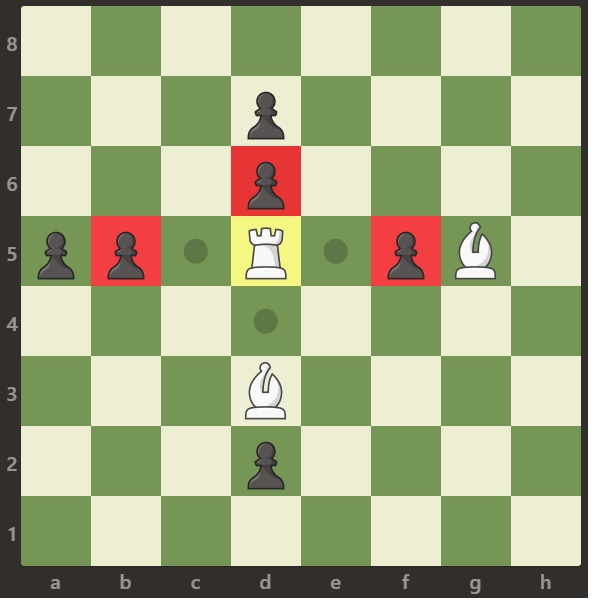
Available Captures for Rook
Input: [[".",".",".",".",".",".",".","."],[".",".",".","p",".",".",".","."],[".",".",".","p",".",".",".","."],["p","p",".","R",".","p","B","."],[".",".",".",".",".",".",".","."],[".",".",".","B",".",".",".","."],[".",".",".","p",".",".",".","."],[".",".",".",".",".",".",".","."]]Output: 3
Explanation:
The rook can capture the pawns at positions b5, d6 and f5.board.length == board[i].length == 8
board[i][j] is either ‘R’, ‘.’, ‘B’, or ‘p’
There is exactly one cell with board[i][j] == ‘R’
Chess Algorithm to compute Available Caputres for Rook in C++
The algorithm is straightforward: iterate each pixel on the chess board which is constant 8×8, as there is only one rook, we can break if we found it.
When we have the position of the Rook, we can move the Rook at four directions (straight and break if the rook meets Bishop, increment the counter if the rook meets a prawn).
1 2 3 4 5 6 7 8 9 10 11 12 13 14 15 16 17 18 19 20 21 22 23 24 25 26 27 28 29 30 31 32 33 34 35 36 37 38 | class Solution { public: int numRookCaptures(vector<vector<char>>& board) { int ans = 0; for (int i = 0; i < 8; ++ i) { for (int j = 0; j < 8; ++ j) { if (board[i][j] == 'R') { // found the ROOK for (int x = i + 1; x < 8 && (board[x][j] != 'B'); ++ x) { if (board[x][j] == 'p') { ans ++; break; } } for (int x = i - 1; x >= 0 && (board[x][j] != 'B'); -- x) { if (board[x][j] == 'p') { ans ++; break; } } for (int x = j + 1; x < 8 && (board[i][x] != 'B'); ++ x) { if (board[i][x] == 'p') { ans ++; break; } } for (int x = j - 1; x >= 0 && (board[i][x] != 'B'); -- x) { if (board[i][x] == 'p') { ans ++; break; } } break; // as there is only 1 Rook. } } } return ans; } }; |
class Solution {
public:
    int numRookCaptures(vector<vector<char>>& board) {
        int ans = 0;
        for (int i = 0; i < 8; ++ i) {
            for (int j = 0; j < 8; ++ j) {
                if (board[i][j] == 'R') { // found the ROOK
                   for (int x = i + 1; x < 8 && (board[x][j] != 'B'); ++ x) {
                       if (board[x][j] == 'p') {
                           ans ++;
                           break;
                       }
                   }
                   for (int x = i - 1; x >= 0 && (board[x][j] != 'B'); -- x) {
                       if (board[x][j] == 'p') {
                           ans ++;
                           break;
                       }
                   }
                   for (int x = j + 1; x < 8 && (board[i][x] != 'B'); ++ x) {
                       if (board[i][x] == 'p') {
                           ans ++;
                           break;
                       }
                   }
                   for (int x = j - 1; x >= 0 && (board[i][x] != 'B'); -- x) {
                       if (board[i][x] == 'p') {
                           ans ++;
                           break;
                       }
                   }
                   break; // as there is only 1 Rook.
                }
            }
        }
        return ans;
    }
};Both time and space complexity is O(1).
–EOF (The Ultimate Computing & Technology Blog) —
推荐阅读:河南卫视在线直播-河南卫视直播在线观看「高清」 北京卫视直播-北京卫视在线直播观看「高清」 天津卫视直播-天津卫视在线直播观看「高清」 安徽卫视直播-安徽卫视在线直播观看「高清」 湖北卫视直播-湖北卫视在线直播观看「高清」 河北卫视直播-河北卫视在线直播观看「高清」 山西卫视直播-山西卫视在线直播观看「高清」 山东卫视直播-山东卫视在线直播观看「高清」 辽宁卫视直播-辽宁卫视在线直播观看「高清」 吉林卫视直播-吉林卫视在线直播观看「高清」
- 评论列表
-
- 添加评论